Introduction to Gregorian Chant Notation
This course provides a solid introduction to the reading of Gregorian chant notation, guiding participants through the graphic system that has preserved and transmitted the liturgical repertoire of the Church for over a millennium.
Through a gradual, practice-oriented approach, participants will become familiar with the fundamental elements of Gregorian notation, including the four-line staff, clefs, simple and compound neumes, the principal rhythmic signs, expressive markings, and the interpretative principles that transform notation into a living musical practice.
Each topic will be explored through the analysis and performance of well-known chants from the Gregorian repertoire, carefully selected for their pedagogical value as well as their liturgical and musical significance. Examples may include Ubi caritas, Salve Regina, Puer natus est, Victimae paschali laudes, Veni Creator Spiritus, together with other chants representing the principal seasons of the liturgical year.
Particular attention will be devoted to the relationship between the Latin text and the melody, ecclesiastical Latin pronunciation, musical phrasing, and the liturgical context of the repertoire, enabling participants to approach Gregorian notation not merely as a writing system but as a means of expressive and informed musical interpretation.
Curriculum and Calendar
The course will take place on Wednesdays from 7:30pm to 9:30pm (CET) and it will be delivered online via Zoom only.
| Date | Session |
| 7th October 2026 | Introduction to Gregorian Chant |
| 14th October 2026 | The Language of Gregorian Notation |
| 21st October 2026 | Reading the Neumes |
| 28th October 2026 | From Notation to Performance |
| 4th November 2026 | Exploring the Repertoire |
| 11th November 2026 | Guided Reading and Practice |
Lecturer
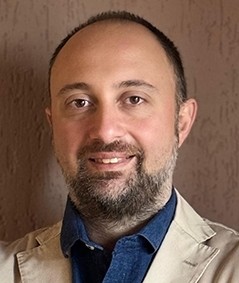
Luca Buzzavi
He obtained a Second-Level Academic Diploma in Pre-Polyphony with top marks from the G. Verdi Conservatory in Turin under the guidance of Maestro Fulvio Rampi, and a Second-Level Academic Diploma in Choral Conducting and Choral Composition (with honors and a special mention) from the G. Frescobaldi Conservatory in Ferrara. He also holds a PhD in Physics, a degree in Educational Sciences, and various university master’s degrees in teaching and pedagogy. He teaches music theory, rhythm, and ear training, as well as individual vocal technique; he is a member of the disability support team and an external expert for school choir projects in primary schools for the C. G. Andreoli Foundation (serving the municipalities of the Northern Modena area). In this capacity, he trains the choral class comprising the “Aurora” children’s and youth choir and has led the “Com’è bello cantar” choir (an ensemble of aphasic patients, in collaboration with the Mirandola-MO Local Health Authority). He is the artistic director of the Accademia Corale Teleion, where he trains and conducts a vocal group performing repertoire ranging from the Middle Ages to the contemporary era. He serves as scientific director and instructor at the Gregorian Chant School promoted by AERCO. Since September 2020, he has conducted the Schola Gregoriana Ecce. He serves on the editorial boards of the specialized journals FarCoro and Dirigo and is an instructor for the regional course for school choir conductors organized by AERCO. He qualified for the AERCO Artistic Commission (2018–2021 term), served on the USCI Lombardia Artistic Commission (2018–2020), has been a member of the AERCO Artistic Commission since 2024, and will serve as its director starting in 2025. He has achieved significant success and recognition in national choral competitions as a conductor, composer, and adjudicator, and has published specialized articles, collections of compositions, and CDs, as well as the studies L’elemento neumatico spiraliforme di Laon239 and Missa S. Simeonis in canto fratto, and a music theory manual. He is a member of the artistic leadership team for the Corinfesta Choral Festival and International Choral Composition Competition. He previously served as Artistic Coordinator for the Voci nei Chiostri Choral Festival in 2017. Having won competitive examinations for teaching Music Education (A030) in lower secondary schools and Choral Conducting for Music Education (CODD01) at the Cuneo Conservatory, he currently teaches Choral Conducting for Music Education, Choral Practice, and Gregorian Chant at the “N. Rota” Conservatory in Monopoli, and Choral Practice at the “Vecchi Tonelli” Conservatory in Modena.